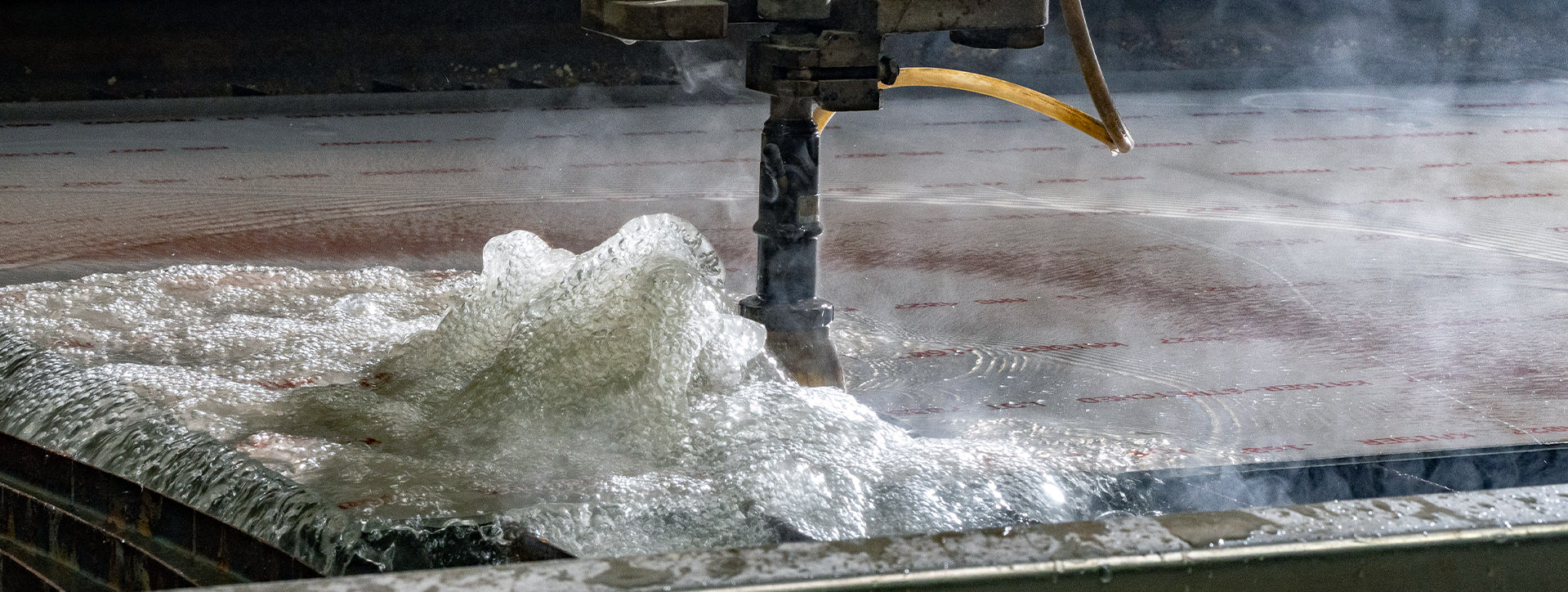
When a customer approached us seeking several sets of stainless steel ring-segment clamps for use on a large circular base plate, we saw an opportunity to approach the job differently. Rings are notoriously inefficient to machine from rectangular sawcut plate – you end up paying for (and wasting) a significant amount of material that never makes it into the finished part. This job turned out to be about as ideal an example of near-net shape manufacturing as we typically see.
The Parts
The finished parts are a set of manufacturing fixtures – specifically, ring segments used as clamps in a downstream operation at the customer’s facility. In cross-section, each ring is L-shaped, with a substantial undercut that allows it to clamp down on a mating surface. There are two versions: a larger and a smaller ring segment.
Quoting Both Ways
As we do on jobs where the material geometry lends itself to it, we quoted the work two ways – starting from sawcut plates and from near-net-shape waterjet blanks. When the near-net approach comes back more expensive or doesn’t offer a meaningful lead-time benefit, we go with the conventional route. In this case, the nesting advantage was substantial. By stacking and nesting multiple rings on the waterjet, we dramatically reduced the starting material compared to what we would have needed for a rectangular sawcut plate.
The Machining Work That Remained
Near net shape doesn’t mean no machining. These parts were CNC-finished on every surface – no raw waterjet edges remain on the final product. Roughly 25 to 30 percent of the material still had to be removed in the mill to create the L-shaped undercut, add holes and counterbores, and put generous edge breaks on everything for safe handling.