KL Engineering offers advanced, customized machining and manufacturing solutions streamlining your process and accelerating time-to-market, helping turn your vision into reality with precision and efficiency.


Streamlining Manufacturing Operations for Powder Conveyance

Case Study: Streamlining Manufacturing Operations for Powder Conveyance

A prominent customer faced critical challenges with their powder-conveyance application, particularly due to recurring weld failures in a stainless-steel bellows weldment. These issues significantly impacted their operational efficiency and reliability. This case study examines how effective collaboration with KL Engineering, Inc. and tailored engineering solutions helped the customer overcome these challenges and enhance their manufacturing processes.

Identifying the Problem

In the manufacturing operation, noncompliance with the customer’s existing design led to recurring joint failures, primarily due to an external misalignment caused by a rigid component. The integration of a bellows was deemed essential to absorb these misalignments and reduce stress on weld joints. However, without prior experience or existing strategies to implement this, the customer faced significant operational hurdles.
 
The customer, an existing partner integrated into a larger system previously designed by KL Engineering, was in a critical situation. The weld failures not only halted production on a specific line but also threatened to propagate issues across their other manufacturing lines, raising alarms about potential widespread downtime and loss of productivity.

Understanding Unique Requirements

To effectively address the situation, KL Engineering needed to analyze and understand the customer’s unique requirements closely. 
These specifications included:
Given the specificity of these criteria, it was clear that an off-the-shelf solution would not suffice.

Collaborative Solution Development

KL Engineering’s project team engaged in a series of discussions with the customer’s internal engineering team to thoroughly understand their needs and expedite the design process. The following steps were critical:
1.) Requirements Distillation

The KL Engineering team utilized its expertise in mechanical design to swiftly distill the complex requirements into a clear set of actionable objectives. This involved assessing the minimum functional level needed to mitigate the risk of further failures while ensuring compatibility with the customer’s operating conditions.

2.) Conceptual Design
After establishing these objectives, the team moved towards conceptualizing a solution that encompassed both standard and non-standard components. The objective was to create a bellows system that could effectively absorb misalignments while remaining within the customer’s dimensional boundaries.
3.) Rapid Prototype Creation
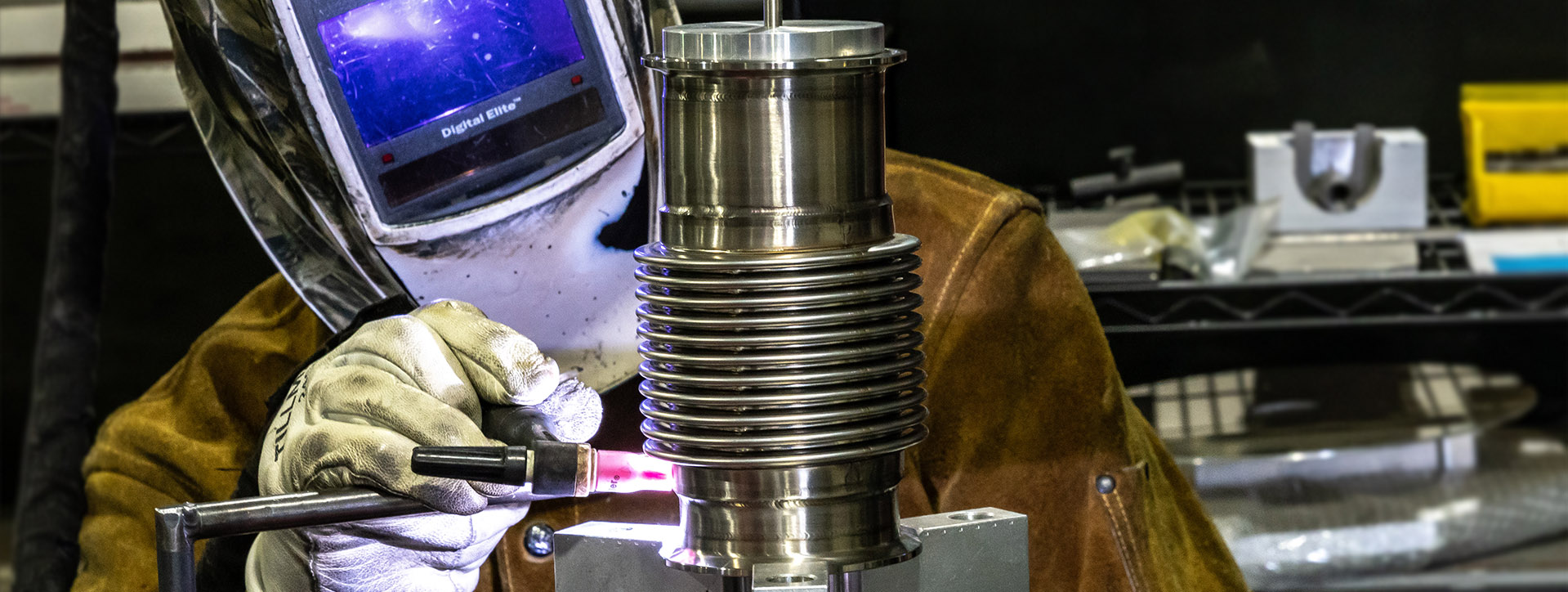
The collaborative effort culminated in the creation of a prototype that featured a custom stainless steel bellows combined with machined parts, adapted to meet the required lengths and connection points. This quick, iterative process was integral to ensuring the solution remained on track to meet the customer’s urgent timeline.
4.) Technical Execution
The technical implementation involved several complex operations tailored to the solution’s unique features. Some of the detailed manufacturing processes included:
          • Precision Machining: The project required advanced machining capabilities, including live-tool turning to produce the tubing for the bellows and machining side holes for flanges that would connect to other components.
          • TIG Welding: High-precision welding was executed using TIG (Tungsten Inert Gas) techniques to assure high-quality joints. This method was chosen for its ability to produce clean and precise welds, which were vital given the operational stresses expected.
          • Leak Testing: To ensure the functional reliability of the bellows system, a vacuum leak check was performed prior to shipment. This testing confirmed that the assembly met the quality standards necessary for operation in demanding conditions.
5.) Rapid Deployment and Scaling
The successful implementation of the solution enabled KL Engineering to respond promptly to the customer’s immediate need. KL Engineering achieved the turnaround of the project in just one week, revitalizing the customer’s critical production line.


Recognizing the potential for similar failures across the customer’s manufacturing operations, KL Engineering promptly initiated the development of retrofit kits. These kits were designed to be deployed swiftly at other installations, enabling proactive measures to safeguard against additional failures.

Performance Comparison

For context, the speed and efficiency demonstrated by KL Engineering stood in stark contrast to the timelines proposed by alternative suppliers. A larger OEM had quoted a lead time of 16 to 20 weeks for comparable solutions, highlighting KL Engineering’s ability to execute under pressure and deliver reliable outcomes within an expedited timeframe.

Customer Impact

The implementation of this solution had immediate and long-term effects on the customer’s operations:

Conclusion

Learn more: Through expert collaboration, innovative engineering, and a commitment to rapid problem resolution, KL Engineering, Inc. successfully transformed a high-risk manufacturing challenge into an opportunity for enhanced operational resilience. The case serves as a testament to the effectiveness of customized solutions in addressing unique technical challenges within manufacturing environments. The integration of specialized components not only resolved immediate concerns but also positioned KL Engineering as a trusted partner for future endeavors in powder-conveyance applications.