
12 Aug Factors Influencing Waterjet Cutting Tolerances
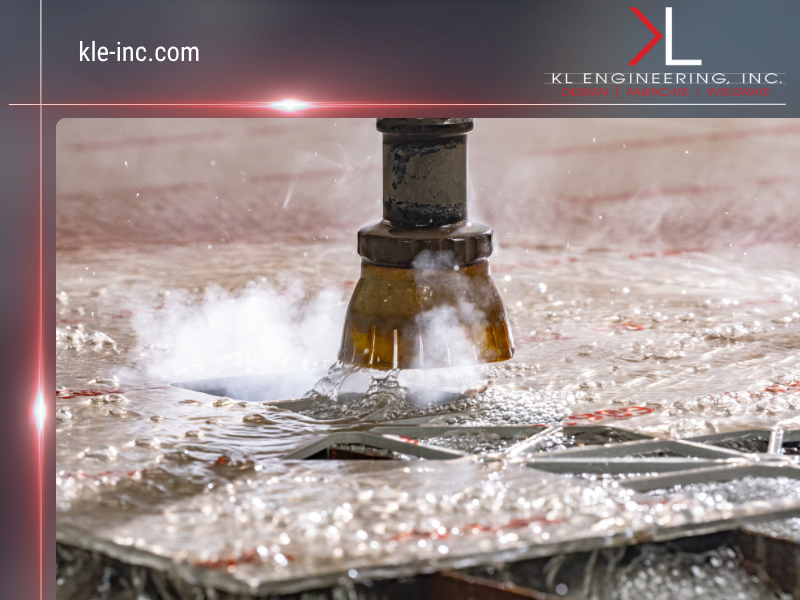
Waterjet cutting is a precise and versatile technique for cutting metals, ceramics, glass, and composites using a high‑pressure waterjet (often with abrasive) to slice complex geometries. Achievable tolerances depend on two distinct but related concepts:
- Absolute achievable accuracy (single part or small batch): the best dimensional accuracy you can obtain when ignoring longer‑term wear. This is dominated by baseline machine accuracy, material properties (hardness, grain/structure), material thickness and flatness, fixturing/part size (smaller parts usually allow tighter tolerances), and process settings (pressure, abrasive type/flow, traverse speed).
- Repeatability / consistency (large production runs): the ability to hold a tolerance across many parts over time. Here, the longer‑time‑scale effects of consumables and wear parts—particularly condition and degradation of the cutting head—become critical. The cutting head state for Part No. 100 may differ from that for Part No. 1, resulting in part‑to‑part variation unless wear is managed.
Material properties and cutting-head setup are the primary determinants of achievable tolerances in abrasive waterjet cutting. Harder workpieces often yield tighter tolerances in single-piece or small-batch work because the cutting stream and erosion are better contained, while very soft materials (e.g., rubber) fail to contain the stream and give poorer accuracy. Kerf behavior and taper are driven more by standoff variation than by simple thickness: an ideal nominal gap between the mixing tube tip and the top of the material must be maintained because any change in that gap allows the uncontained stream to diverge, altering kerf width and dimensional accuracy. Wear parts within the cutting head (orifice, mixing chamber, mixing tube) degrade accuracy as they wear, and incoming-plate residual stresses can cause parts to spring, bow, or climb as they are cut—often producing far larger flatness errors than modest within-sheet thickness variation. Finally, minimum feature size and hole quality are constrained by nominal kerf diameter, pierce-related chipping in brittle materials, and the need for lead-in/lead-out features rather than by cutting pressure or short-run abrasiveness.
Achieving desired tolerances at a glance
| Part size and batch scale | Feature size | Maintenance and consumables | Cost vs. tolerance tradeoff |
| Tighter tolerances are generally easier on smaller parts and short runs because flatness, thickness variation, and machine repeatability effects are better controlled over small areas. Large runs of small parts cut from one large sheet can lower material and handling costs. Still, they may increase per‑part variability due to uneven material flatness or cumulative machine/consumable drift. | Minimum feature and kerf considerations are set by nozzle size, jet taper, and material behavior. Smaller features magnify the influence of material variation and machine error, so feature limits should be chosen based on the tighter of absolute accuracy and expected run‑to‑run repeatability. | Proactive preventive maintenance is critically important – not only for uptime but because it directly affects tolerances. Holding tight tolerances across large batches increases maintenance and consumable usage (nozzles and other wear parts), raising per‑part costs compared with looser tolerances. | Specifying tighter tolerances across large volumes typically increases cost due to more frequent consumable replacement, additional inspection, tighter process control, and possible rework. Balance tolerance requirements against allowable per‑part cost and production volume. |
What do we recommend?
- Collaborate with our applications team: Our engineers and application specialists are available to work with you on part‑specific recommendations to reach the right balance of cost, lead time, and accuracy.
- Choose the right mix of processes: For many parts, it’s cheaper and faster to keep most waterjet cuts at looser tolerances and finish a few critical features with a secondary operation (e.g., simple milling) to achieve tighter dimensions. This hybrid approach can reduce runtime, lower cost, and shorten lead time while meeting functional requirements.
- Quote transparency: We’ll separate cost drivers in quotes – basic cutting, secondary operations (milling/finish), and any special inspection or setup – so you can see how tighter tolerances or added processes affect per‑part cost.
- Leverage alternative technologies: If another process (milling, laser, stamping, etc.) better meets a component’s needs, we’ll recommend it or combine methods to optimize performance and price.
Achieving consistent, tight tolerances requires designing the job around both the absolute accuracy possible on the machine and the repeatability sustained over the intended production run, with maintenance and consumable management explicitly baked into process and cost estimates.
Let’s Build the Right Solution – Together.
At KL Engineering, capability and flexibility unite to serve one purpose: your goals. We don’t believe in one-size-fits-all. Instead, we tailor every project to fit your unique needs, seamlessly aligning with your processes and priorities. Ready to move forward with a partner who adapts to you? Visit our website or contact us today to get started on your next project: www.kle-inc.com.